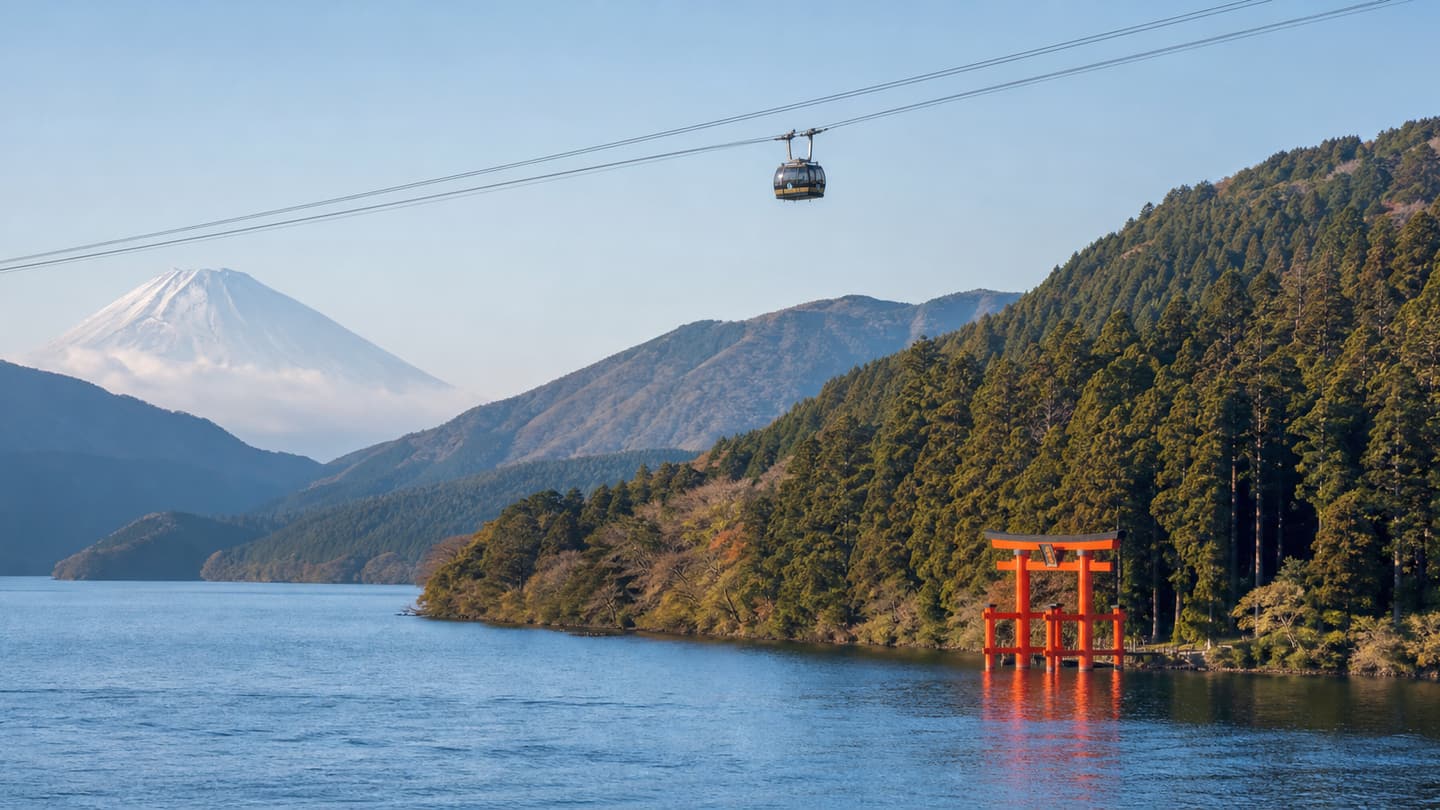
Hakone’s trains, cable car, ropeway, buses and Lake Ashi cruise form a memorable journey, but transfers make the day sensitive to crowds and weather. Decide the trip length before adding attractions.
What the loop actually is
The “Hakone loop” is not one vehicle. It is five different ones in sequence, and every join between them is a place where a queue can form. Odakyu’s own station guide lists the chain: Hakone-Yumoto → Gora → Sounzan → Owakudani → Togendai → Hakonemachi-ko / Motohakone-ko → Odawara, covered in turn by a mountain railway, a cable car, a ropeway, a lake cruise and a bus.
Two things follow from that shape, and they matter more than which attractions you pick.
The chain is only as reliable as the ropeway. It is the segment most often suspended — for wind, and for volcanic activity at Owakudani. When it stops, the loop does not simply slow down; the middle falls out of it and you are on a substitute bus. Odakyu publishes live transport status and it is worth reading on the morning you go, not the week before.
Everyone travels the same way round. The default direction most guides describe sends the whole day’s arrivals through each transfer in the same order, at the same time.
Consider going the other way
Odakyu itself publishes a reverse-course itinerary specifically to avoid the crowds — that is the operator’s own suggestion, not a trick. Running the loop backwards puts you at each transfer out of step with the main flow.
There is also a crowd forecast for the area. Checking it costs a minute and can move your trip by one day into a much better one. Almost nobody does this.
Direction is worth deciding deliberately rather than inheriting from the first itinerary you read.
The focused day trip
A day trip can follow part of the classic loop through Gora, Owakudani and Lake Ashi. Start early, select only the stops you genuinely want and keep a return route that does not depend on completing every segment.
The practical rule for one day: pick the segment you actually came for, and treat the rest as optional. If it is the ropeway view, protect that and be willing to skip the cruise. If it is Lake Ashi, you can reach it by bus without the ropeway at all. Trying to complete the full circuit and stop properly at museums or an onsen is the single most common way a Hakone day turns into a day of transfers.
Build the return so it does not depend on finishing the loop. If you are on the far side when something stops running, you want a bus route back rather than a problem.
When one night is better
Stay overnight if an onsen or ryokan meal is central to the trip, if you want a substantial museum visit, or if you prefer a buffer against transport changes. An overnight stay also avoids turning the last connection to Tokyo into the day’s main concern.
The middle option exists too: a day trip with a proper bath. Odakyu sells a day-use ticket for Hakone Yuryo — one of the larger day onsen — at ¥1,700–¥3,600 per adult depending on the plan (child ¥1,000), read on the operator’s ticket page on 23 August 2026. So “onsen” does not have to mean “overnight”.
Where your suitcase goes
The mountain railway and the cable car are small, and the ropeway cabins are smaller. A large suitcase is genuinely awkward on this route, and awkward for everyone else in the carriage with you.
If you are passing through Hakone between two cities rather than returning to the same hotel, sort the luggage out before you start the loop rather than carrying it round. Our guide to airport and hotel luggage delivery covers how the forwarding services work; the same logic applies city to city.
Choosing a pass
Do not assume one pass is automatically cheapest. Compare its covered area and validity with your actual route. Confirm whether the product includes transport from your departure station or only travel within Hakone.
Two questions decide this, and neither is about the headline price:
- Does it cover getting there, or only getting around? Some products start at your departure station in Tokyo; others begin once you are in Hakone. That difference is larger than the difference between passes.
- Are you actually riding every segment? A pass covering the full loop is poor value if the ropeway is suspended that day, or if you have decided to skip the cruise. Price your real route, then compare.
What the Hakone Freepass costs
Odakyu publishes the whole table, so here it is. First read on 2 August 2026 and re-verified on the operator’s official page on 23 August 2026:
| From | 2 days | 3 days |
|---|---|---|
| Shinjuku, adult | ¥7,100 | ¥7,500 |
| Shinjuku, child (6–11) | ¥1,600 | ¥1,850 |
| Odawara — Hakone area only, adult | ¥6,000 | ¥6,400 |
| Odawara — Hakone area only, child | ¥1,500 | ¥1,750 |
This is the table in force since Odakyu’s 1 October 2025 revision, which moved the Shinjuku 2-day pass from ¥6,100 to ¥7,100. The Shinjuku version includes the round trip to Odawara. The Odawara version does not include any Odakyu Line travel — that is the “does it cover getting there” question above, priced.
The Romancecar is always extra. A reserved seat from Shinjuku to Hakone-Yumoto adds ¥1,200 each way for an adult and ¥600 for a child, and buying that online saves ¥50. Odakyu does its own arithmetic on the page: Freepass ¥7,100 plus a round-trip Romancecar ¥2,400 comes to ¥9,500 from Shinjuku.
There is no 1-day version. Odakyu says so itself, and argues the 2-day pass still pays off on a day trip. Its own comparison for an adult doing the classic route: going via JR totals ¥9,200, against ¥7,100 with the Freepass from Shinjuku — a ¥2,100 difference, before the pass’s discounts at around seventy facilities.
Children under 6 travel free. The pass covers eight transport modes.
If Owakudani is the main target, there is a cheaper pass
The Owakudani 2-Day Pass covers the mountain railway, the cable car and the ropeway section up to Owakudani, plus a discounted Odakyu round trip — but not the cruise or the rest of the loop. Odakyu’s own worked example, read on 23 August 2026: from Odawara the pass costs ¥5,000, against ¥5,460 of regular transport fares for the same route plus ¥650 for Hakone Gora Park — ¥6,110 paid separately, so the pass saves ¥1,110. If your day is Owakudani and Gora rather than the full circuit, this is the better product.
Two traps in the Freepass small print, both worth more than the price itself:
- Two days does not mean 48 hours. The day you buy it is day one whatever the hour, and a two-day pass expires after the last service on the following day. Buying at 4pm gives you an evening and a day.
- A digital pass is one per smartphone, one per person. A child without their own phone cannot hold a digital Hakone Freepass. Travelling with children who have no smartphone means buying paper.
Prices change, so check before you buy — but a stale figure is easier to correct than no figure at all, which is what this article used to offer.
What the stops cost
The pass covers the transport; the stops are mostly extra. Three anchors, all read on the operator’s pages on 23 August 2026:
- Lake Ashi cruise. Covered by the Freepass. Paid separately it is ¥3,000 per adult round trip, and the deluxe cabin adds ¥800 one-way — pass holders get ¥100 off the cabin surcharge.
- Hakone Open-Air Museum. ¥2,000 per adult, reduced to ¥1,900 with the pass.
- Day-use onsen. Hakone Yuryo’s admission ticket runs ¥1,700–¥3,600 per adult (child ¥1,000) depending on the plan.
Official planning sources
- Hakone Navi official itineraries: https://www.hakonenavi.jp/international/en/course
- Hakone Navi official transport and passes: https://www.hakonenavi.jp/international/en/
- Hakone Freepass official detail and price table: https://www.hakonenavi.jp/international/en/discount_passes/free_pass
- Owakudani official information: https://www.kanagawa-park.or.jp/owakudani/
- Hakone Navi live transport status: https://www.hakonenavi.jp/international/en/status_information
- Hakone Navi crowd forecast: https://www.hakonenavi.jp/international/en/crowd_forecast
- Hakone Navi reverse-course itinerary: https://www.hakonenavi.jp/international/en/course/829
Frequently asked questions
Is there a 1-day Hakone Freepass?
No — the 2-day pass is the shortest version, and the operator says so itself. It can still pay off on a day trip: Odakyu’s own comparison puts the JR alternative at ¥9,200 against ¥7,100 with the pass from Shinjuku.
Can I see Mount Fuji from Hakone?
Views are weather-dependent and should be treated as a bonus, not a guaranteed part of the itinerary.
Is the full loop mandatory?
No. A partial route is often better when service changes, crowds or personal mobility make the full circuit impractical.
Which direction should I go?
Either works. The operator publishes a reverse itinerary specifically to avoid crowds, so the standard direction is a convention rather than a requirement. Decide it deliberately.
What happens if the ropeway is closed?
A substitute bus generally covers the section, but it changes the character of the day — you lose the view that is the reason most people ride it. Check the live status page in the morning and be ready to reshape the day around Lake Ashi or the museums instead.
Can I do Hakone as a day trip with luggage?
You can, but the railway, cable car and ropeway are all small. If you are moving on to another city rather than returning, forward the bags instead of carrying them round the loop.
Spotted an error? Email [email protected].